10 Things to Like About the Hierarchy of Hazard Controls
Tracing its origin to the early 1900s, the Hierarchy of Hazard Controls — the inverted pyramid still used today — has changed little since the 1970s. Depending on how you measure it, the model has remained useful for somewhere between 55 and 125 years.
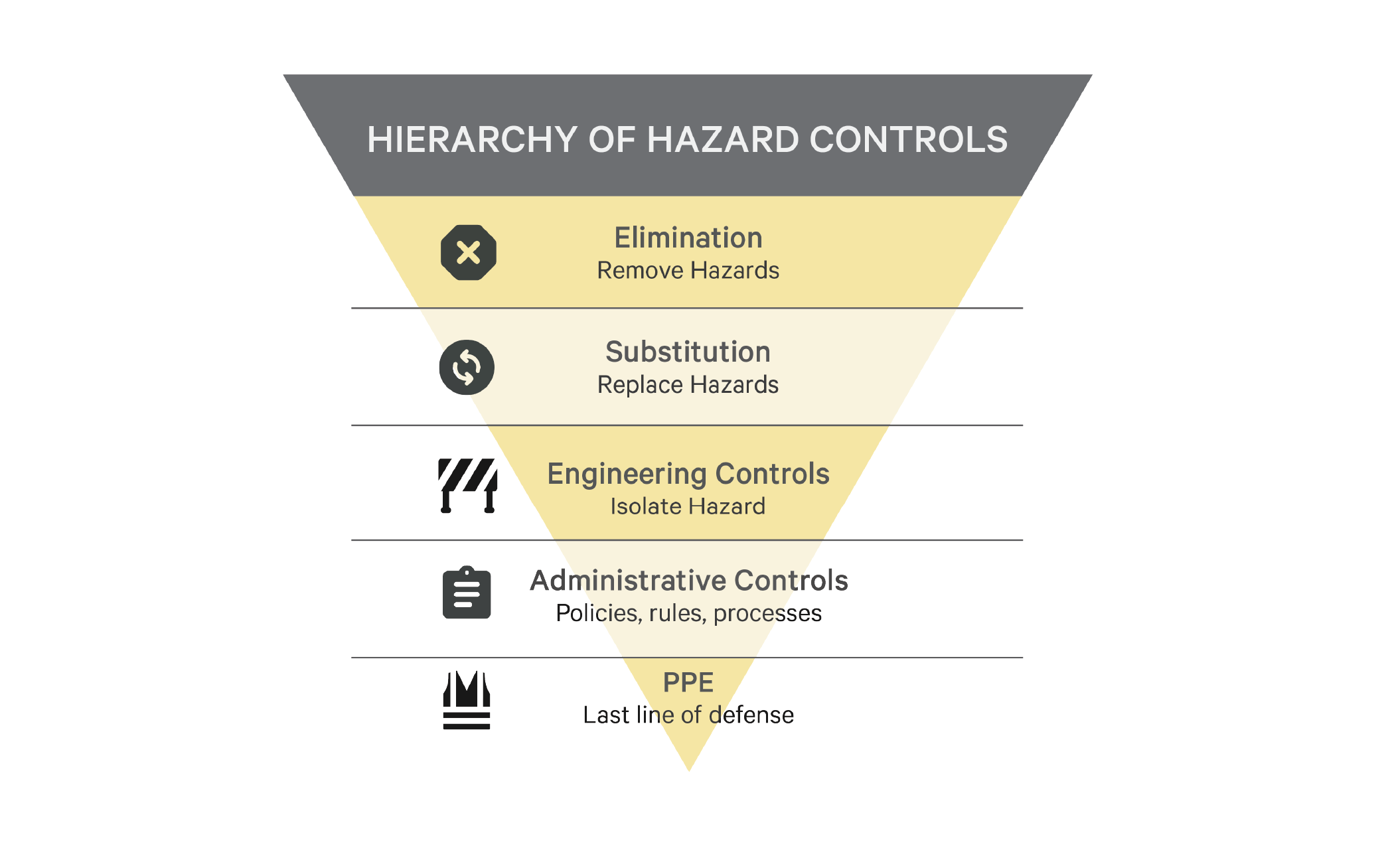
Its longevity is not accidental.
The hierarchy is not an instruction set. It is a model. And as George Box observed, “all models are wrong, but some are useful”. An instruction set tries to be complete. A model gives you a way to think.
The hierarchy works because you can carry it in your head. It gives teams a shared language. And it helps turn risk decisions into deliberate choices.
Here are ten ways to look at it that may sharpen how we use it.
1. A reliability scale
The hierarchy is a ranking of how likely a control is to work when it is needed. Fewer moving parts lead to fewer failure modes. Fewer failure modes lead to higher reliability.
Elimination and substitution are inherently more reliable than procedures and PPE because they remove dependence on human performance.
2. Inverted people-dependence
As you move down the hierarchy, reliance on people increases. A physical barrier works whether someone remembers it or not. A rule only works if someone remembers and follows it. Lower controls assume consistent human behaviour. Higher controls reduce that assumption.
3. A design-first mindset
The hierarchy nudges us to solve risks at the design stage, not the operational stage.
Designing out a hazard at the blueprint phase is fundamentally different from managing it at the worksite. One reshapes the system. The other manages exposure within it.
4. A budget for attention
Human attention is limited.
Controls that depend on vigilance, memory, and compliance compete for the same scarce resource. When a risk is eliminated, no one needs to think about it. But PPE, signage, and procedures require ongoing attention.
The hierarchy quietly reminds us not to overspend that attention.
5. A forecast of failure
Every control can fail.
The hierarchy guides what acceptable failure looks like. Controls with the highest potential impact should be hardest to fail, while those more likely to fail should sit where consequences are lower. In this way, probability aligns with consequence.
6. A hierarchy of stability
Higher-order controls create stable conditions. They do not shift with staffing levels, fatigue, or weather.
Lower-order controls are more dynamic. They depend on training, reinforcement, and ongoing supervision. The higher you move, the more the safety condition becomes built-in rather than maintained.
7. A map of responsibility
Higher controls tend to sit with organisations, designers, and decision-makers, while lower controls tend to sit with frontline workers.
In that sense, the hierarchy is also an ethical statement. Those with greater power, resources, and time have greater capacity to move controls upward.
8. A spectrum of influence
As you move up the hierarchy, controls become broader and more systemic.
Guardrails influence everyone who enters a space, while training reaches only those who attended. The hierarchy helps identify the level at which your action will have the widest effect.
9. A signal of what should be temporary
Some controls hold their strength over time. Others fade unless they are renewed.
PPE and administrative controls are not weak; they are simply less durable. They require replacement, retraining, and reinforcement.
When you rely on them, you should do so consciously — and consider whether something more permanent is possible.
10. A memory aid for complexity
The hierarchy is deliberately simple.
That is its strength. In complex environments, it provides a stable reference point. But simplicity also carries a warning: it should guide thinking, not replace it.
The hierarchy is a lens, not a rulebook.
So what?
The hierarchy is not just a teaching tool. It is a decision tool.
Each time you review a risk, ask one question: Can this be moved one step higher?
Technology alone does not do that. Adoption does.
SEEN strengthens controls within your existing safety system.
Guided Adoption — available during or after installation — helps ensure it is embedded deliberately, encouraging you to look up and down the hierarchy for solutions instead of defaulting to more rules or more vigilance.
The hierarchy gives direction.
Guided Adoption helps you act on it.