From Knowing About Safety to Being Safe
Do you know how to drive a car or write with a pen?
How good are you at it? Probably very good — or at least well practised.
So practised, in fact, that if I ask you to picture yourself doing either, you don’t stand outside the action watching it happen. You place yourself inside it.
Then, if I ask — where do you end? When you drive, do you stop at the steering wheel, or do you also experience the road? When you write, is your hand merely holding the pen or do you feel the nib meet the paper?
For most people, the answer is obvious once it’s noticed. We are what we use. Or at least, what we use often and well.
This isn’t philosophy. It’s well-understood neuroscience.
It sits under the idea of proprioception — our sense of body position and movement — with one important clarification: that sense does not end at the skin. When a tool is used consistently, with feedback, the brain incorporates it into what it considers to be the body itself. So when we are driving — we are the car through to the road. And when we are writing — we are the pen through to the paper.
The realisation that this happens is probably not that profound to an experienced driver or writer. What is perhaps more surprising is that there is a word for it at all. And what is interesting is the effect this has on us.
Once well practised, it moves us from being a bystander to participating in an experience that feels like part of us. And we respond differently. Faster. More intuitively. With less distance.
In short, we move from observing an activity to — and keep this idea in your head — being actively engaged.
From Observation to Engagement
This is why the idea matters for safety culture.
Research consistently shows that culture is the single largest contributor to creating a safer work environment. This is not a “nice to have”, nor is it soft or secondary — not something to address through posters, slogans, or after-work events.
Culture is, or should be, a first-class part of any safety strategy.
The problem is that creating and sustaining culture is hard. You cannot mandate it, and you cannot spreadsheet it into existence. And the reason it is hard is the same idea we’ve just been talking about.
Culture depends on active engagement. It is not a bystander activity. It only really works when people are participating — when the tools they use and the work they do operate as one.
Experiences are hard to explain until you’ve had them. The car and the pen are easier to grasp. Trying to think of yourself extended through a safety system is much harder.
But think back to learning to drive. Driving a car is very complex. It involves all of your limbs, and all of your senses. Often acting at the same time but for different reasons. But even when you put that all together on top of all the rules you have to follow, the aha moment comes not from intellectually knowing how to drive, but instead understanding in your gut what it is to be a driver. When distance, speed, grip, and risk stopped being abstract and started being felt. When you no longer calculate what to do, you simply know how to react. You are not a bystander at the steering wheel. You are actively engaged as a driver.
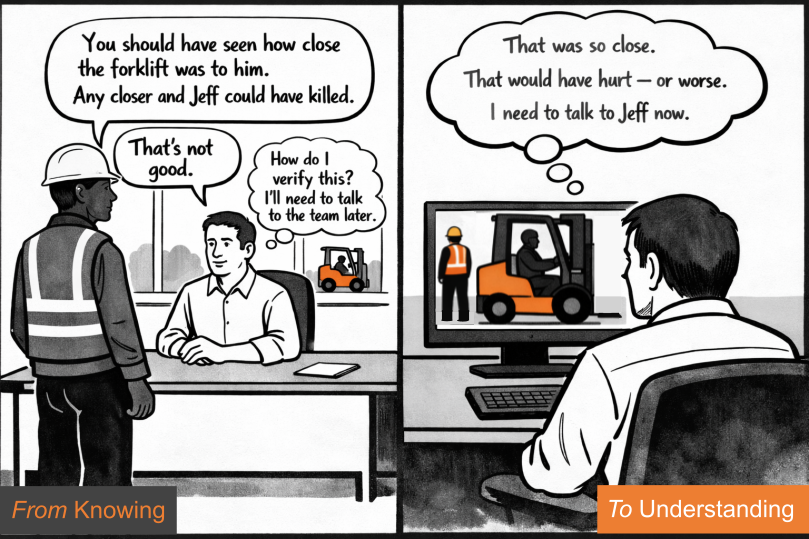
From Understanding to Perception
That’s not knowledge. That’s perception. And once that perception is there, behaviour changes without being argued into place. It is instinctive and looked for. When you drive and conditions change — you adapt. Change is not resisted, it is expected.
That’s what you need from a modern safety system: not another layer of process, but an extension of how you and your people perceive and respond to risk.
When safety tools work this way, engagement follows naturally.
Turning Engagement into Practice
This is why SEEN offers Installation and Adoption as an addition to the SEEN System.
Install
Installation is not about taking you out of the driver’s seat. As discussed, active engagement is essential. Installation simply removes unnecessary friction at the start — much like having a car brought to you when your time is better spent elsewhere.
Guide
Adoption is about guidance.
You can reach your destination on your own. Most organisations eventually do. But learning where to look, what matters, and how to respond takes time — and along the way, there are wrong turns, delays, and avoidable risks.
A guide doesn’t replace experience. They accelerate it. They help you develop the right instincts sooner by placing you in the right situations, with the right feedback, at the right time. You remain responsible for the journey. The guide helps you move along it more quickly and with greater confidence.
That is the role Installation and Adoption is designed to play: not to command, but to advise; not to take over, but to shorten the distance between intent and practice.
From SEEN user, to being SEEN.