Why 100% Accuracy Is Impossible for AI Human-Form Recognition Cameras
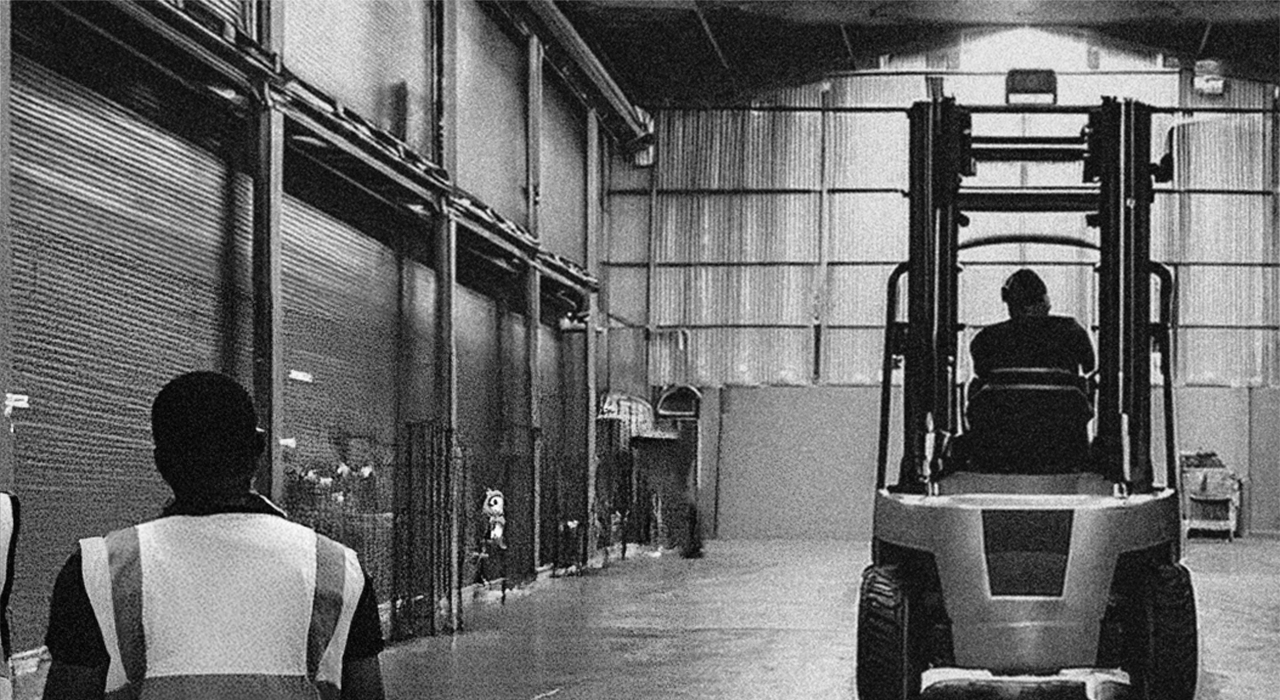
In industrial environments, AI cameras designed to recognize people face an uncomfortable truth: 100% accuracy is not achievable in the real world. This isn’t a limitation of any specific vendor or model—it’s a fundamental constraint of vision-based AI itself.
Any system that interprets images must constantly balance two opposing errors:
Missed detections (false negatives): a person is present, but not detected
False alarms (false positives): the system signals a person when none is there
Reduce one, and the other increases. Perfect accuracy—zero misses and zero false alarms—does not exist outside controlled lab conditions. The real question isn’t whether errors will occur, but which failure mode you’re willing to accept.
The Trade-Off Every AI Camera Must Make
AI human-form detection works by assigning a confidence score to each potential detection and comparing it to a threshold:
Lower the threshold: fewer missed detections, more false alarms
Raise the threshold: fewer false alarms, more missed detections
There is no threshold that maximizes both precision and recall at the same time. This is a mathematical reality of classifiers—not a tuning problem that can be solved with better data or better models.
In safety-critical environments—such as pedestrians operating around forklifts or mobile equipment—the cost of a missed detection is far higher than the cost of a false alert. As a result, systems are typically tuned to be highly sensitive, accepting frequent false alarms by design.
That decision has consequences.
When Both Outcomes Increase Risk
Missed detections can lead directly to serious incidents when a person goes undetected in a danger zone.
False positives cause unnecessary slowdowns, emergency stops, and alarm fatigue.
Over time, systems that cry wolf lose credibility. Operators learn to ignore alerts—or disable systems altogether—undermining the very safety they were meant to deliver. This is why accuracy percentages alone are a poor proxy for real-world safety performance. Failure mode matters more than averages.
Why Real-World Conditions Make It Worse
Even well-trained AI models degrade rapidly outside controlled environments. Everyday industrial conditions include:
Occlusion: people partially blocked by pallets, machinery, or vehicles
Lighting challenges: low light, glare, backlighting, rain, fog, dirty lenses, motion blur
Pose and appearance variation: crouching workers, carried loads, unusual PPE, extreme angles
Visual clutter: human-shaped objects, signage, reflections, shadows
Site variability: different layouts, camera heights, uniforms, and workflows
These are not edge cases—they are normal operating conditions.
Detection vs. Interpretation
The limitation isn’t that AI is ineffective. It’s that using passive vision alone to make a life-critical yes/no decision has inherent limits. Every AI camera must guess—based on pixels—whether something looks like a person. That guess always lives on a knife-edge between missed detections and nuisance alarms.
A more reliable approach starts by changing the question:
Not “Does this look like a person?”
But “Is there a strong, unmistakable physical signal that a protected person is present?”
SEEN takes a different approach. Instead of relying solely on passive image interpretation, the system uses active, tagless detection.
Anchoring Detection in Physics, Not Probability
Infrared laser light is emitted and specifically looks for the powerful return signal from retroreflective tape already present on standard high-visibility PPE. Retroreflective materials are engineered to send light directly back to its source, producing a signal that is:
Extremely strong
Highly specific
Not confused by shadows, clutter, or object shapes
If compliant high-visibility PPE enters a danger zone and line-of-sight exists, the signal is detected—no confidence thresholds, no probability tuning.
Because this approach leverages existing PPE standards such as ANSI/ISEA 107 and ISO 20471, deployment is consistent across fleets and sites.
Where AI Belongs: In the Loop, Not the Critical Path
AI still plays an important role—but after detection, not for the detection itself.
Once a physics-based sensor confirms the presence of retroreflective PPE, AI is used to:
Organize and classify events
Add visual context and metadata
Enable analytics for training, layout optimization, and policy improvement
The life-critical decision—is a person present?—does not depend on a confidence score. It’s grounded in a measurable, repeatable physical signal.
The Bottom Line
AI vision is powerful—but it will always be forced to choose between missed detections and nuisance alarms. That trade-off cannot be engineered away.
By anchoring detection to physics rather than probability, and using AI for insight instead of life-critical decisions, SEEN avoids the knife-edge entirely. The result is pedestrian detection that is simpler, more consistent, and easier to trust—exactly what industrial safety systems should be.