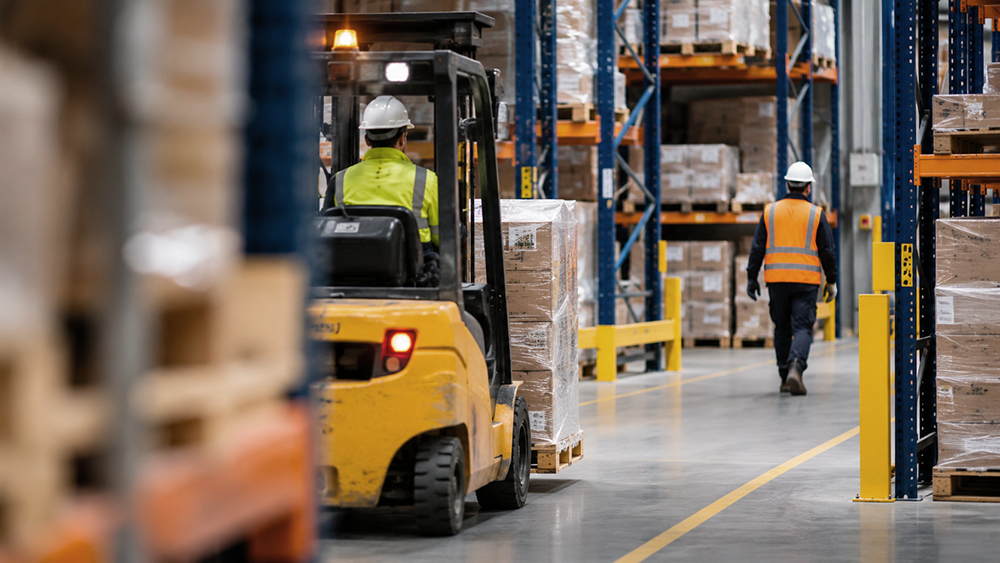
A workplace can go months without a reported forklift incident. That doesn't necessarily mean the risks are under control.
Every day, forklifts and other mobile equipment operate around pedestrians, machinery, infrastructure, and valuable assets. Most interactions end without injury or damage. But how many of those interactions were actually safe?
How many involved a pedestrian stepping unexpectedly into a forklift's path? An operator braking suddenly? A near collision with valuable equipment? And how many went completely unreported?
If you're measuring safety primarily by what goes wrong, you could be missing much of what's happening before it does.
The problem with relying on incident reports
Incident reporting is an essential part of workplace safety. But it has an obvious limitation: it depends on someone recognizing, remembering, and reporting what happened. Even near-miss reporting can leave gaps. In busy operations, potentially hazardous interactions can become so routine that they're barely noticed. Workers adjust, operators react, and the day continues.
Nothing happened. So nothing gets recorded.
But an avoided collision isn't necessarily evidence of an effective safety system. It could simply mean someone reacted in time.
That's an important distinction for any business relying on low incident numbers as reassurance that its safety measures are working.
Are you managing risk or just responding to outcomes?
Most organizations have established safety controls: pedestrian segregation, traffic management, training, high-visibility PPE, and operating procedures. These remain fundamental. But having controls in place isn't the same as knowing how effectively they're working in everyday operations.
Consider a loading area where pedestrians repeatedly enter the path of moving forklifts. If no collision occurs, the existing arrangements might appear effective. But repeated hazardous interactions could indicate a problem with traffic flow, procedures, or how work is organized.
Without visibility into those interactions, how would you know?
The real question isn't just whether your safety controls exist. It's whether you have the evidence to understand where they need strengthening.
More warnings aren't necessarily the answer
When businesses look to technology to improve mobile equipment safety, the conversation often focuses on detection capabilities.
What can the system detect? How far away? How accurately?
These are important questions. But they're not the only ones worth asking.
A system that generates alerts without helping people understand the underlying risks may provide additional awareness without necessarily driving lasting improvement. The greater opportunity is to connect real-time detection with information that helps safety teams identify patterns, investigate recurring hazards, and make better decisions. It's the difference between knowing that a potentially hazardous interaction occurred and understanding why similar interactions keep happening.
From counting incidents to understanding exposure
Imagine being able to identify where potentially hazardous interactions occur most frequently, review what contributed to them, and assess whether changes to operating procedures are making a difference.
That information can help businesses move beyond reacting to incidents toward addressing risks before they result in harm or damage.
At SEEN Safety, we believe active detection has a role to play in both immediate awareness and longer-term safety improvement. By combining detection with actionable safety intelligence, businesses can gain greater visibility into risks around people, property, and assets.
Because ultimately, the absence of incidents tells you what hasn't happened. Understanding everyday interactions can help you identify what needs to change.
What risks are going unseen in your workplace?
Discover how SEEN Safety can help you gain greater visibility into potentially hazardous interactions around mobile equipment.