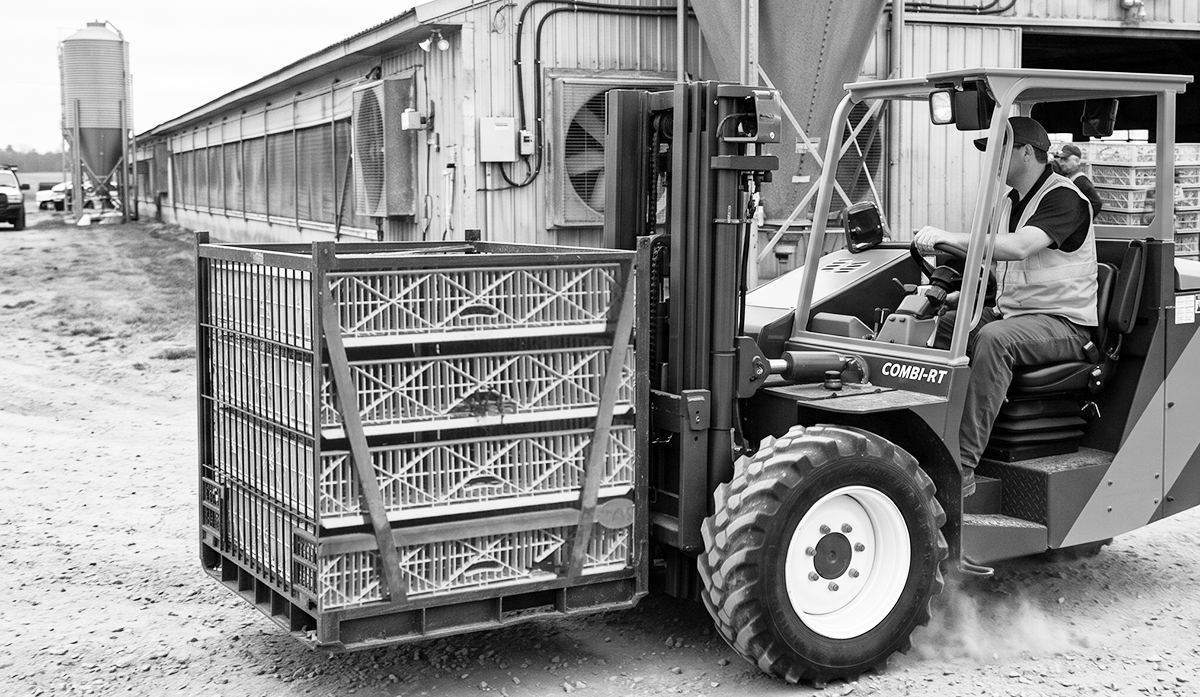
Example image only. Customer identity in this article has been anonymized at the organization's request.
Turning Detection Data Into Safer Habits:
How a large Australian producer used real-time alerts and SEEN Insight footage to reinforce 3-meter exclusion zones around moving machinery.
Managing pedestrian safety around mobile machinery is one of the toughest challenges in modern agriculture. While physical separation is always the gold standard, real-world farm operations don’t always allow for rigid barriers.
For a large Australian poultry producer, this tension was a daily reality. Over a seven-week pilot program, however, the company demonstrated how pairing smart sensor technology with targeted staff coaching can dramatically reduce close calls, reinforce safer habits, and drive high-visibility PPE compliance to 100%.
The Challenge: When Shared Workspaces Are Unavoidable
In commercial poultry farming, critical operational tasks—such as chick placement, rotary hoeing, and live bird pickup—frequently require ground workers and heavy machinery to operate in close proximity.
The producer had already followed best-practice safety protocols, establishing fixed and dynamic exclusion zones wherever practical. Yet, because of the nature of the work inside and around sheds, complete physical separation wasn't always possible.
Early site monitoring highlighted several persistent risks in these shared workspaces:
Pedestrians working too close to moving machinery
Inconsistent adherence to high-visibility clothing requirements
Gaps in seatbelt use
Unsafe habits when approaching active equipment
The Solution: Adding an Intelligent Layer of Defense
Working within the Hierarchy of Hazard Controls, the producer had already eliminated hazards and substituted safer equipment where feasible. To manage the residual risks in shared zones, they equipped tractors used in key farm operations with the SEEN Safety System.
Unlike standard cameras that rely on complex visual processing, SEEN sensors use infrared laser technology to reliably detect the retroreflective tape on workers' high-visibility clothing. The moment a pedestrian enters a configured detection zone around a tractor, the system triggers an immediate audible alert—giving both the operator and the worker vital seconds to react.
Crucially, the system didn't just beep in the moment; it fed data into SEEN Insight, converting every detection into a reviewable event complete with charts and video footage.
Turning Data Into Lasting Behavioral Change
Technology alone rarely solves a safety challenge—it’s how teams use the information that makes the difference. Throughout the seven-week pilot on a participating farm, the producer’s safety team reviewed the detection data and video clips every week, using real examples to guide regular staff briefings.
Instead of generic safety reminders, supervisors could show teams exactly where and why close interactions were happening, reinforcing the right way to respond to alerts.
By the end of the seventh week, weekly pedestrian detections had dropped significantly—falling from nearly 290 in Week 1 to roughly 70 by Week 7. Beyond the numbers, supervisors observed clear shifts in day-to-day behavior:
100% Hi-Vis Compliance: Because the sensors rely on retroreflective tape, high-visibility clothing compliance quickly hit 100% across the site.
Better Spacing: Pedestrians consistently maintained the required 3-meter separation distance, and high-risk interactions directly in front of machinery (within 1.5 meters) declined.
Clearer Communication: Workers routinely signaled drivers before approaching equipment, while operators stopped machinery sooner and in safer positions.
Proactive Safety Through Smarter Insights
Perhaps the biggest win came from the patterns uncovered in the data. SEEN Insight revealed that near-miss activity consistently peaked between 10:00 and 11:00 a.m., and spiked noticeably at the start of a new production cycle. Armed with this knowledge, the safety team could proactively deploy extra supervision and targeted coaching during high-risk windows rather than waiting for an incident to occur.
By combining real-time alerts with visual evidence and consistent coaching, this poultry producer turned invisible daily risks into measurable, lasting safety improvements.
Ready to gain clear visibility into pedestrian risks on your site?
Discover how SEEN Safety can help turn detection data into safer working practices.