Why Visibility Alone Isn’t Enough: Pairing Retroreflective PPE with a Pedestrian Detection System
Retroreflective tape is one of the most recognizable safety tools in industrial workplaces.
It is simple, affordable, and effective at helping workers stand out in low-light conditions and visually busy environments. In workplaces where pedestrians and heavy mobile equipment operate in close proximity, appropriate high-visibility PPE is an important part of a strong safety program.
However, there is an important question that is often overlooked:
Does being more visible guarantee that you will be detected?
The answer is no—and that distinction matters.
Because if a pedestrian safety strategy depends on an operator seeing a worker, what happens when that worker cannot be seen?
Visibility is not the same as detection
Retroreflective material improves visibility when light reaches the material and the wearer is within the direct line of sight of someone looking in their direction.
There are many benefits to using retroreflective PPE in high-risk workplaces, but equipment operators do not always have a clear view of the people around them.
Blind spots are a reality around mobile equipment. Loads can block sightlines, mast structures can restrict visibility, turning and reversing can continually change an operator’s field of view, and busy environments can compete for an operator’s attention.
A worker can be wearing high-quality retroreflective PPE and still remain outside an operator’s view when sightlines are limited.
This is the key limitation of relying on visibility alone: high-visibility PPE can help a worker be seen, but it cannot guarantee that an operator will see them.
Why blind spots remain a critical risk
Near misses can occur even when workers are wearing the correct PPE because the equipment operator may never have had a clear line of sight in the first place.
Retroreflective material cannot see around corners, detect someone behind a load, or monitor areas outside an operator’s field of view.
That creates an important question for safety teams: Are your pedestrian safety controls designed primarily to make workers more visible, or are they also designed to address situations where workers cannot be seen?
As industrial workplaces become faster-paced and more complex, relying on human vision alone can leave gaps in the controls used to manage pedestrian and mobile equipment interactions.
The value of pedestrian detection
Pedestrian detection provides something PPE cannot: an additional layer of awareness.
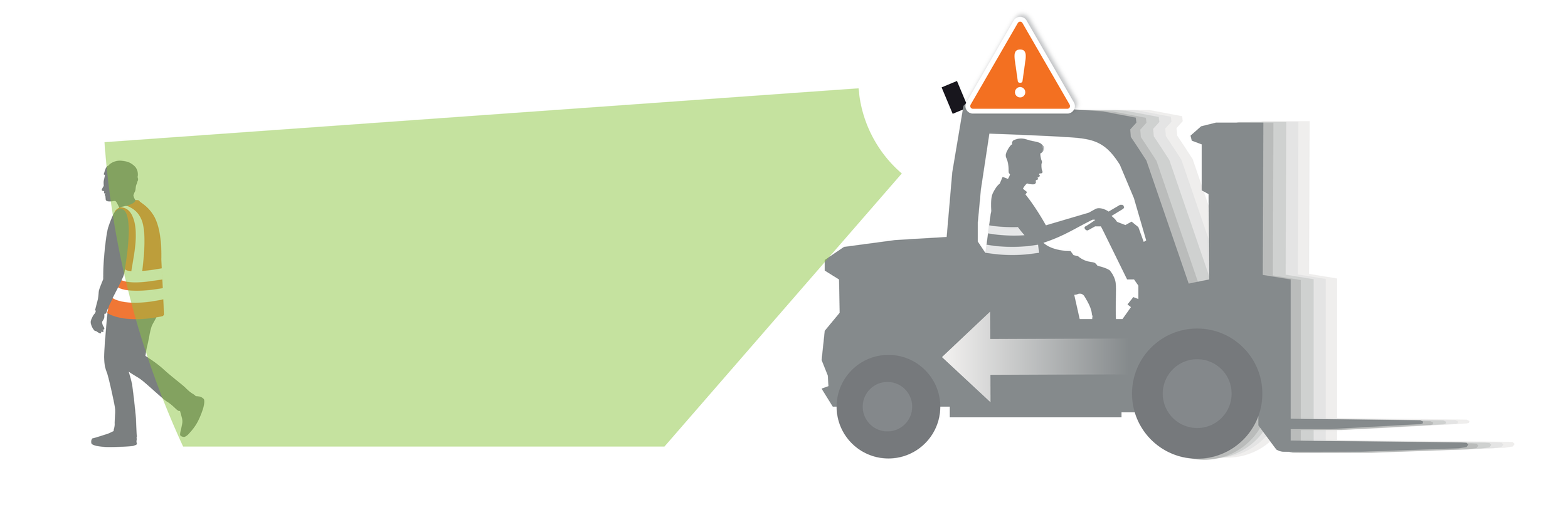
A pedestrian detection system can monitor defined risk zones around mobile equipment and alert an operator when a pedestrian is detected in an area that may be difficult or impossible to see from the cab.
But the value of pedestrian detection can extend beyond an alert in the moment.
Pedestrian detection technology can also provide valuable data about pedestrian-equipment interactions, helping safety teams identify recurring near misses, blind-spot activity, and potential high-risk areas before they contribute to an incident.
In many ways, pedestrian detection acts as another set of eyes around the equipment—providing an additional source of information when an operator’s direct visibility is limited.
The operator remains responsible for safely operating the equipment, but pedestrian detection can provide an additional layer of protection by helping identify risks that might otherwise go unnoticed.
Stronger protection comes from layered safety controls
Introducing pedestrian detection should not be viewed as a choice between PPE and technology.
The stronger approach is to use them together.
Retroreflective PPE helps workers stand out when they are visible to an operator. Pedestrian detection can add another layer of awareness when direct visibility is compromised.
Together, these controls address the same risk from different angles.
The benefits can extend beyond real-time alerts. Data collected by a pedestrian detection system can help safety teams identify patterns in near misses, repeated pedestrian-equipment interactions, blind spots, and other high-risk areas.
This information can support decisions about traffic management, facility layout, training, operating procedures, and other preventive safety measures.
Instead of waiting for an incident to reveal a problem, organizations can use this data to better understand where risk is occurring and take action earlier.
A question for safety leaders
Consider this scenario:
A worker is wearing the required high-visibility PPE but is standing in a forklift blind spot. What control is protecting that worker at that moment?
If the answer depends primarily on the operator seeing the worker, then there may be a gap in the layers of protection between pedestrians and mobile equipment.
PPE remains essential, and retroreflective material continues to play an important role in workplace safety.
But the question safety leaders should be asking is no longer simply whether workers are visible enough.
It is whether their safety controls still work when a worker isn’t visible at all.