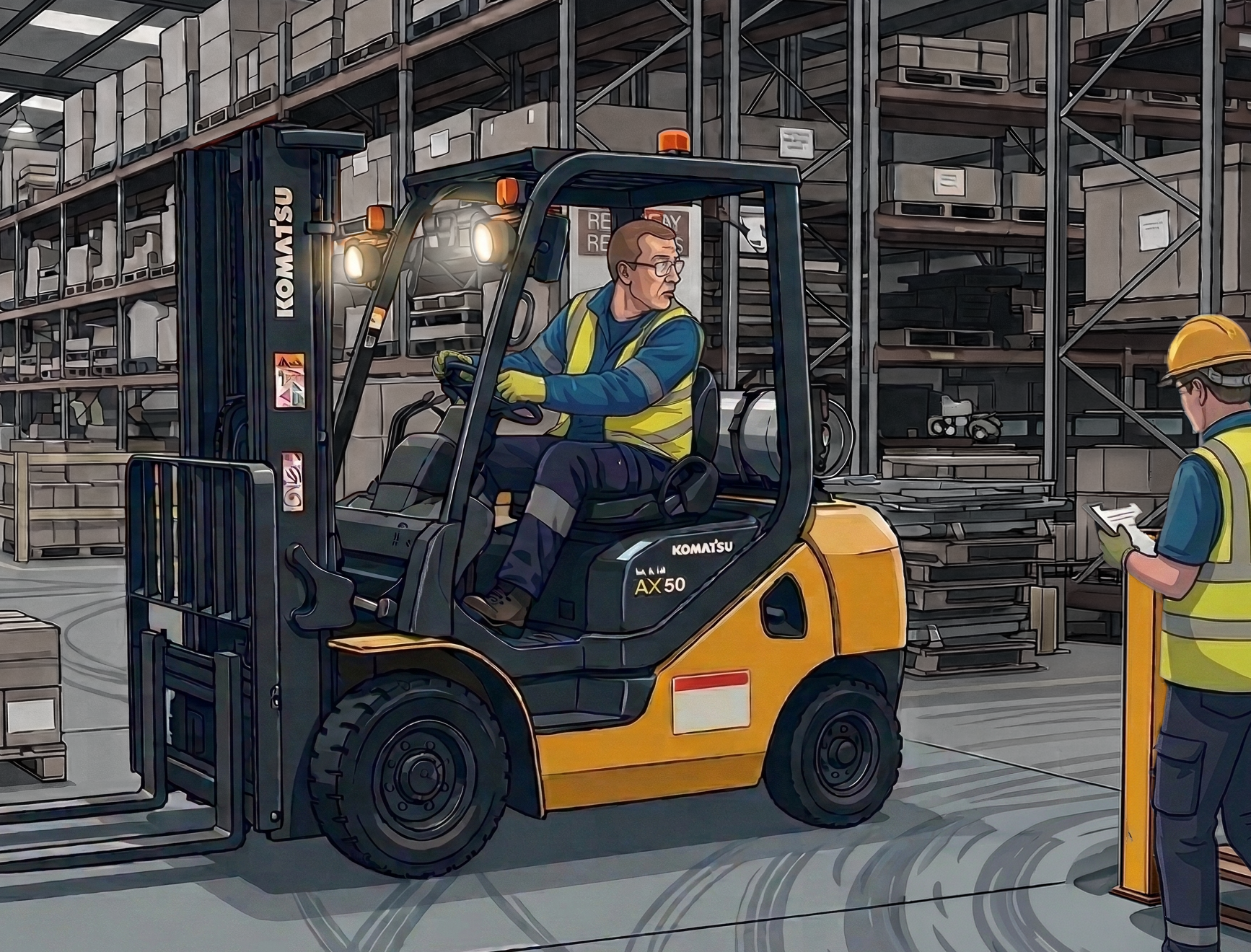
Pedestrian detection on forklifts is becoming standard. The next question health and safety leaders ask is predictable:
“Can we make the truck slow down automatically… or even stop?”
That sounds like the obvious next step, but in reality, “automatic slowdown” is where safety technology stops being a sensor project and becomes a machine-integration decision—with trade-offs that can reduce risk or create new hazards if deployed without due diligence. The sensor isn’t the hard part, the forklift interface is.
What “machine slowdown” actually means in the real world
When sensor vendors claim they can slow a forklift, they usually mean one of three approaches:
1) Trigger an OEM slow-speed mode
Many electric forklifts already support reduced-speed / crawl / “turtle” modes. In that case, the safety system does not “control speed” directly, it simply sends a signal that requests the forklift’s existing slow mode. This is often the easiest approach because you’re not rewriting vehicle control—you’re simply making use of a pre-existing OEM mode.
2) Use a professional speed limiter / throttle override module
If the truck doesn’t expose a usable crawl-mode input—or you need consistent behavior across different makes and models—specialist companies use a dedicated module that limits the speed request. This can work on a wider range of trucks, but it’s also why those vendors maintain large harness libraries and installation programs. It’s professional integration work, not a generic “just wire in a relay.”
3) “Stop” or traction inhibit
Some solutions do talk about graduated interventions such as walking speed, then stop. But once you move from assist to automatic stopping, the bar rises fast:
false positives become much more consequential,
deceleration behavior must be predictable with load/grade/surface,
and the whole system starts looking like a safety function—because users will rely on it.
For these reasons, it’s still uncommon to use a sensor input to command a full stop on a forklift, and it should only be considered with careful engineering, validation, and clear site acceptance criteria.
OSHA guidance: what it tells you—and what it doesn’t
OSHA’s powered industrial truck (PIT) standard and guidance focus heavily on operator-controlled safe operation: i.e. keep the truck under control, slow down where visibility is limited, avoid behaviors that increase tip risk, and handle loads in a stable manner.
What OSHA does not provide is a universal “safe deceleration rate by load weight and lift height.” That gap matters if you introduce automatic intervention—because you now own the question: “Will this slowdown be safe under real load conditions on our site?”
If you’re going to automate motion reduction (and especially stopping), you need to validate:
deceleration behavior with representative loads,
behavior on grades and slippery floors,
load stability and tip risk during interventions,
and the real-world nuisance activation rate.
References
OSHA 29 CFR 1910.178 (Powered Industrial Trucks): https://www.osha.gov/laws-regs/regulations/standardnumber/1910/1910.178
OSHA PIT eTool (Traveling/Maneuvering guidance): https://www.osha.gov/etools/powered-industrial-trucks/operating-forklift/traveling-maneuvering
OSHA PIT eTool (Load handling/stability basics): https://www.osha.gov/etools/powered-industrial-trucks/load-handling/load-composition
Why safety managers want to reduce or remove the human factor
The push for automatic slowdown isn’t about mistrusting operators—it’s about recognizing that even well-trained, well-intentioned people can make mistakes, especially under pressure. Automation is attractive because it can:
standardize compliance (slow zones are slow zones, every time),
reduce reliance on reaction time and attention,
reduce variability between operators and shifts,
create a “backstop” for when people are tired, rushed, distracted, or new to the job.
In other words, it can reduce risk in the moments humans are more likely to be inconsistent.
The potential for unintended consequences
Automatic slowdown can reduce risk—but it can also introduce new ones if not managed carefully:
1) Over-reliance and risk compensation
If operators learn “the truck will brake for me,” attention can drop and some people may drive faster into risk areas, follow more closely, or take tighter gaps—because the system becomes part of their mental model.
2) Nuisance slowdowns change behavior
False positives aren’t just annoying, they can create genuine operational pressure that leads to:
unsafe workarounds,
degraded trust in the sensor’s alerts,
congestion and new collision modes,
or pressure to disable the system entirely.
3) Load stability surprises
Intervening at the wrong time (while turning, on uneven surfaces, with raised loads) can create serious secondary hazards: load shift, dropped loads, or increased tip risk.
Two-stage slowdown: why it’s common and what “good” looks like
Many customers prefer a two-stage slowdown approach that reduces risk without making every detection event feel like an emergency stop:
Stage 1 (early warning) → slow to a “walking speed” / crawl mode
Stage 2 (critical alert) → slower creep mode, but not a full stop
Some systems explicitly describe multi-step interventions to a full stop, but stopping is a separate decision with a higher burden and should be treated accordingly.
A practical way to avoid common failure modes
If you’re considering automatic slowdown, consider using an approach like this:
Start by using the sensor for assistance only, and for collecting data. Validate the detection quality, understand your traffic patterns, and map any near misses.
Choose the least invasive integration first. If the forklift supports an OEM crawl/slow mode input, start there. Ensure the reduced speeds are appropriate for the working conditions and loads.
Run a pilot and measure it against some well considered acceptance criteria, such as:
nuisance slowdown rate,
operator feedback and behavior changes,
operational throughput impact,
and load stability observations under representative conditions.
Can SEEN do machine slowdown?
Yes—SEEN can do it. We output staged signals (early warning and critical alert) that can trigger:
OEM crawl/slow modes on compatible forklifts, and/or
partner speed control modules where deeper speed limiting is needed.
The right approach depends on your fleet mix, your risk model, and what your trucks actually support—which is why this should be engineered site-by-site, not assumed.
Slowdown isn’t a feature — it’s a safety system design decision
Automatic machine slowdown can be a powerful risk-reduction layer by accounting for human error, improving consistency, and lowering collision risk in the moments that matter most.
But it can also introduce new hazards—nuisance interventions, operator over-reliance, traffic flow changes, and load stability issues—if it’s deployed without careful integration, validation, and change management.
The decision to automate slowdown (and especially to full stop) is complex, context-dependent, and shouldn’t be taken lightly. It deserves serious thought, controlled testing, and the right integration strategy for your trucks and your site.
SEEN can help you navigate that complexity. If you’re wondering whether machine slowdown is appropriate for your operation, talk with us—we’ll help you choose the safest, most practical approach for your fleet and your risk profile.
Considering automatic forklift slowdown?
Explore the safest, most practical approach for your fleet, with expert guidance on compatibility, integration and operational risks.