Turning High-Vis into Real Protection: The Case for Mandating High-Visibility Apparel, and Enhancing It
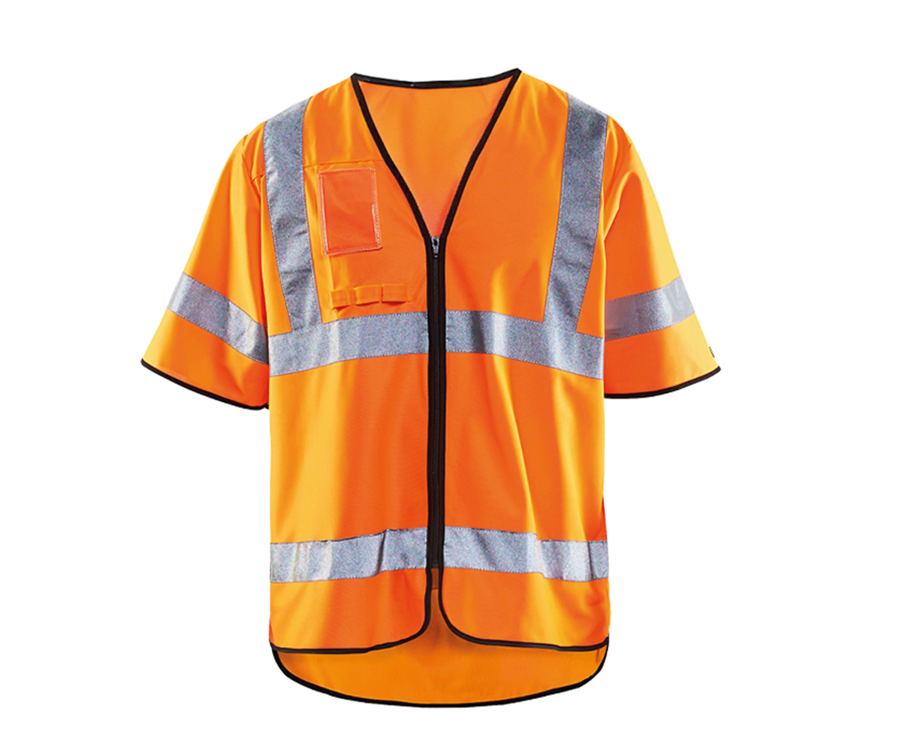
High-visibility apparel is one of the simplest, lowest-cost ways to protect workers around forklifts and other mobile equipment.
Yet, many organizations still don’t require it, treating it as an optional accessory rather than the fundamental piece of Personal Protective Equipment (PPE) that it is.
That gap creates real exposure. In busy, fast-moving environments, operators can only react to what they can see, and without high-vis apparel workers blend into the background far more often than leaders realize. In areas with moving equipment, a high-vis vest is just as crucial as a hard hat or steel-toed boots—it is a core barrier against one of the most common catastrophic workplace injuries: the struck-by incident.
Industry safety associations and regulators—like OSHA, NSC, and ASSP—consistently highlight visibility as a core control for preventing struck-by incidents. Simply put: high-vis works. It increases detection distances, improves reaction times, and gives operators more opportunity to avoid a collision.
But today’s best-performing safety programs don’t stop at mandating high-vis—they enhance it. Traditional high-vis is passive: it depends entirely on where an operator is looking at any given moment. Modern active-detection technology closes that gap by transforming the reflective strip workers already wear into a signal that equipment can detect automatically, triggering an audible alert the moment a person is too close.
This shift turns standard high-vis from “something workers wear” into a smart, proactive safety layer that supports operators, reinforces compliance, and significantly reduces risk. For companies looking to strengthen their visibility controls without adding complexity, enhancing high-vis is one of the highest-impact, lowest-friction upgrades available.
Yet, some HSE leaders resist even mandating high-vis apparel in their facilities. Here’s why that resistance is risky — and how combining policy with technology creates a far more robust safety solution.
Why Mandating High-Vis PPE is Fundamental: It's the Hard Hat of Struck-By Prevention
1. Regulatory and Duty-Based Rationale
OSHA’s General Duty Clause (Section 5(a)(1)) requires employers to provide a workplace “free from recognized hazards.” When struck-by risks are present—such as in areas with moving vehicles—failing to require high-vis apparel may be considered a violation. A safety program cannot be considered complete if it mandates boots and hats but ignores the core visibility protection. OSHA+2OSHA+2
OSHA’s enforcement directive confirms that not ensuring employees in struck-by risk zones wear high-visibility safety apparel can result in citations. OSHA
According to OSHA’s “Powered Industrial Trucks / Pedestrian Traffic” guidance, pedestrian walkways should be clearly marked; forklifts should yield to pedestrians; and where possible, vehicles should use alarms, horns, and lights to alert people nearby. OSHA
Industry safety associations reinforce this. For example, The National Safety Council (NSC) offers practical warehouse / PIT guidance that highlights pedestrian/vehicle separation, operator vigilance, and the role of PPE / visibility in preventing powered-industrial-truck injuries. nsc.org+1 The American Society of Safety Professionals (ASSP) provides membership guidance and articles that explicitly recommend using ANSI/ISEA class-2 or 3 high-visibility safety apparel in traffic / work-zone contexts and provide practical steps for creating safer work zones. www.assp.org+1.
2. Standards Matter — Not All High-Vis PPE Is Equal
The ANSI/ISEA 107 standard defines classes of high-vis garments (Class 1, 2, 3) based on task risk, background complexity, and movement. wholesafety-ppe.com+1
According to safety-industry guidance, Class 2 or Class 3 garments are often required in high-risk, vehicle-traffic areas because they offer superior visibility via a combination of fluorescent background and reflective tape. ceiwc.com+1
Employers should use their hazard assessments (per OSHA 1910.132) to determine which class of high-vis garment is appropriate — they cannot simply rely on low-spec vests when risk is high. Workplace Material Handling & Safety
The Risk of Not Mandating High-Vis — Especially without Reinforcement
Even when high-vis is “available,” compliance can be inconsistent: workers may skip vests, choose low-visibility classes, or use them improperly. Without a clear, enforced policy, the protection offered by hi-vis may not be fully realized.
Material-handling environments are dynamic. Forklifts have blind spots, sudden starts/stops, and limited braking capacity. As OSHA’s guidance notes, operators should always sound the horn at corners, blind areas, and when reversing. OSHA
A lack of high-vis policy can expose a company to legal, regulatory, and reputational risk. If there’s a struck-by incident and no mandate for high-vis, the defense becomes much harder.
How Active High-Vis Alerts Transform Safety: From Passive to Proactive
Here’s how an active retroreflective-detection system (like SEEN’s) enhances safety beyond mere compliance:
Real-time Warning: By sensing the retroreflective strip on high-vis gear, the system can trigger an audible alarm when someone wearing high-vis enters a defined proximity to a vehicle. That gives both the pedestrian and the equipment operator an immediate alert.
Behavior Reinforcement: Because the system only functions if a worker is wearing retroreflective high-vis, it incentivizes correct PPE usage. Workers know that neglecting their high-vis could silence the alert system that protects them.
Data & Insights: Alarm logs and event data provide HSE teams with actionable metrics — frequency of near-misses, hotspots in the facility, times of day when risk is highest. That supports continuous improvement.
Making the Case: Best Practices for HSE Leaders
To build buy-in and drive stronger safety culture, consider:
Updating your PPE policy to require ANSI/ISEA-standard high-vis garments in all zones where pedestrian and vehicle interactions exist.
Designating zones for pilot deployment of the active alert system — for example, in aisles, blind corners, or high-traffic shared spaces.
Benchmarking and measuring near-miss incidents or alarm events during a pilot, then scaling based on ROI (reduced risk, behavior change, cost avoidance).
Training staff and leadership on the new system: explain why high-vis matters, how the alarm works, and how everyone benefits.
Embedding the system in your safety culture: celebrate compliance, but also use data to spotlight risky zones and vulnerable practices.
The Numbers Don’t Lie—Evidential Insights
High-visibility apparel is one of the most proven and widely endorsed controls for reducing struck-by incidents—but its effectiveness is often underestimated until the data is seen in one place. This Evidence Snapshot brings together research from safety regulators, industry associations, and empirical field studies to illustrate just how critical visibility is in fast-moving, equipment-dense environments. The insights below highlight why leading enterprises not only mandate high-vis apparel, but increasingly look for ways to enhance it with active detection technologies that close human-factor gaps and deliver measurable ROI.

Conclusion
Refusing to mandate high-vis PPE because “we don’t have a policy” or “it hasn’t been a problem yet” is a risky posture—especially in environments with moving equipment. That hesitation leaves a gap in protection that is both foreseeable and preventable.
By instituting a robust high-vis policy and layering in active detection via an audible alert system, companies can shift from reactive to proactive safety. In doing so, they not only meet regulatory expectations but elevate visibility into real behavior and risk — protecting their people in a far more meaningful and measurable way.
Want to read more?
A Field Guide to Retroreflective PPE and Markings
High-Visibility PPE is the bare minimum—but what if it could do much more?
Further Reading & References
OSHA Interpretation Letter on Hi-Vis Apparel & the General Duty Clause OSHA
OSHA Enforcement Directive: Citing Failure to Provide High-Visibility Clothing in Struck-By Hazards OSHA
OSHA eTool: Pedestrian Traffic and Powered Industrial Trucks OSHA
NGFA Safety Alert on Working Around Mobile Equipment ngfa.org
ANSI/ISEA 107-2020 High-Visibility Standard Overview wholesafety-ppe.com
EL-COSH Guide: High-Visibility Clothing in Heavy / Highway Construction elcosh.org
OSHA Warehouse Pedestrian Safety Tips Occupational Health & Safety